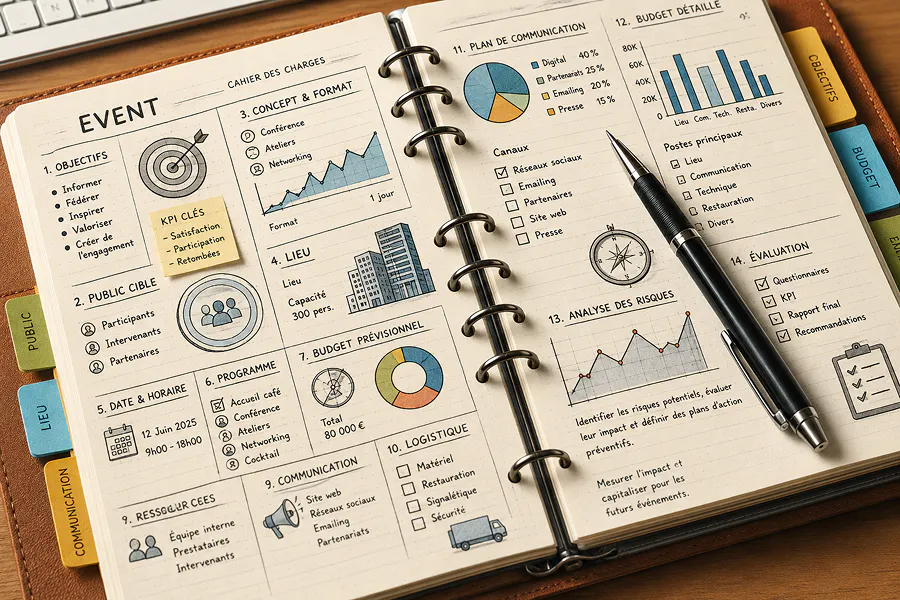
Choosing an event platform is rarely decided on signing day. The verdict is prepared well before, in a document that's often underestimated: your event RFP. Poorly framed, it leads you to the wrong event platform. Well built, it becomes the most powerful lever to align your teams, compare vendors on objective criteria, and secure a strategic investment.
At Digitevent, we support more than 3,000 organizers of professional events and respond to hundreds of RFPs every year. Some are excellent: short, prioritized, driven by business objectives. Others are completely unusable: 400 flat lines of features, no mention of security, not a word about support.
The gap between the two isn't a question of resources. It's a question of method.
This article gives you the 10 concrete keys to choosing your next event platform through a workable RFP. Three steps: frame your need before writing a single specification, write clear functional and technical requirements, and evaluate vendors with the rigor such a strategic investment deserves.
By the end, you'll have a repeatable method for your next consultation.
Framing your event platform choice first
A good RFP doesn't start with a feature.
It starts with a question: why are we changing platforms? This question seems obvious. Yet it's missing from one RFP out of two. The result? A consultation run without direction, vendors answering off the mark, and a final choice dictated by price for lack of a better compass.
Key 1 - Define your business objectives first
An RFP for an event platform serves a project, not a specifications document. Before drafting a single requirement, define what you expect from the future event platform: qualified lead generation, customer loyalty, post-event sales performance, improved attendee experience, measurable ROI.
Pick out one or two primary objectives. Everything else becomes secondary.
Then quantify these objectives with concrete indicators: registration rate, attendance rate, post-event NPS, sales leads generated. And document what happens if you keep your current stack. The cost of inaction is often higher than the cost of change.
Key 2 - Map your internal stakeholders
An event platform RFP is never a single team's job. According to Forrester's 2026 study on the state of B2B buying, a B2B software decision involves an average of 13 internal stakeholders and 9 external ones. Better to anticipate them.
Identify every stakeholder upfront: marketing, communications, IT, procurement, legal, DPO, HR for internal events, finance for the budget. Each has their own "must haves". IT will require SSO SAML and data localization. Marketing will want deep customization. Legal will ask for a DPA ready to sign.
Name a single sponsor. Only they decide in case of disagreement. Without this arbiter, your RFP risks lacking coherence.
Key 3 - Define your real event scope
How many events do you organize per year? What sizes? In-person, hybrid, remote? Single-site or multi-country? What's the peak concurrent usage?
This data determines the fit of an event platform. A vendor built for 50 internal seminars a year won't properly handle a 5,000-attendee convention. Conversely, oversizing your platform will cost you dearly for nothing.
The French event industry is worth €5.5 billion in investment in 2024-2025, up 17.6% according to Unimev's 2025 Event Data Book. Volumes are rising, and so are requirements. Plan for growth over at least 24 months. A tool sized for today will be too narrow tomorrow.
Now you're ready to write. This is where everything can still go wrong.
Specifying without turning into a shopping list
This is the phase that derails most RFPs.
The natural reflex is to stack up expected features. 300 lines weighted equally, ambiguous questions, checkboxes. Serious vendors give up. The others answer "Yes" to everything. You end up drowning in unusable responses.
Key 4 - Prioritize requirements as Must / Should / Nice
A workable event specifications document ranks needs into three levels: Must, Should, Nice. And it standardizes the expected responses, for example Yes, Configuration, Customization, Roadmap, Not supported.
This hierarchy changes everything. It forces your team to decide internally before asking the question. It stops vendors from answering "Yes" across the board. It gives you a scoring grid you can use right away.
Cover the essential building blocks of professional event management software: registration, ticketing, event website, attendee app, check-in, badges, networking, communication, reporting. For every Must requirement, ask for a screenshot or a targeted demonstration. That's what separates promises from actual delivery.
A concrete example: for the registration block, don't just ask "does the platform handle registrations?". Ask whether it handles your specific cases. Named invitations, access codes, conditional forms, multiple pricing tiers, multi-stage validation, payments in several currencies. It's the depth of the answer that will separate serious vendors from the rest. Every ambiguous line in your event specifications will be exploited commercially. Be precise.
Key 5 - Address security and GDPR in the first section
Security isn't an appendix item. It opens your RFP.
Data localization within the European Union, encryption at rest and in transit, authentication (SSO SAML, MFA), fine-grained role management, audit logs, identified subprocessors, certifications (ISO 27001, SOC 2, HDS if sensitive data). These elements belong at the start of the document, not the end.
Require a DPA ready to sign as early as the response phase. Ask for the full list of subprocessors. Check the terms for data reversibility in case the contract ends.
An event platform processes thousands of pieces of personal data. You are the data controller. Not the vendor.
Key 6 - Measure the depth of integrations
A platform isolated from your information system doesn't create value. It destroys it.
List the expected integrations precisely: Salesforce, HubSpot, Marketo, Pardot, Workday, Slack, Teams, enterprise SSO. Ask for the technical documentation of the public API. Check webhook availability. Ask about custom field governance and two-way data synchronization.
Ask for customer integration cases on a stack comparable to yours. A vendor that can't name a reference close to your context has probably never handled this in production.
A company uses dozens of SaaS applications on average. Your future platform is just one piece of that whole. It has to talk to the others without friction.
Key 7 - Demand a clear framework for data and KPIs
Many vendors promise "powerful reporting". Few say what they actually measure.
List the expected indicators: registration rate, conversion rate, no-show rate, attendee app engagement, post-event satisfaction, qualified lead generation. Ask for dashboard examples. Specify the expected export frequency and accepted formats (CSV, API data, BI).
Also ask about outcomes, not just outputs. How many qualified leads were produced for their previous clients? What change in attendance rate? What reduction in cost per attendee? A platform that can't answer these questions doesn't have enough usable track record.
You now have a solid specifications document. What's left is choosing the right vendor behind it.
Evaluating vendors without getting swept away
This is where the decision is won or lost.
Too many organizations spend 80% of their energy writing the RFP and only 20% on evaluation. This balance is backwards. A well-rehearsed demo can easily hide a product's weaknesses. Three keys help you dig beneath the surface.
Key 8 - Weight support and human accompaniment heavily
An event tolerates neither downtime nor a ticket sitting unanswered for 24 hours.
Ask precisely about support terms: days and hours covered, available channels (chat, phone, email), response SLA, on-call coverage for strategic events (evenings and weekends included), a named Customer Success Manager, a detailed onboarding plan.
Require a name, a language, a time zone. Ask for a quantified use case on average response time. Call two or three references to verify the CSM's operational maturity.
"For major accounts, the platform + Customer Success pairing makes 80% of the difference on the day. A perfect tool without a human behind it always fails. The reverse is true too.", Lucas Boheme, Head of Major Accounts at Digitevent
The weight given to support in your scoring grid should reflect this real importance. 20 to 25% minimum isn't excessive.
Also ask about escalation. What happens if a blocking incident occurs an hour before doors open? What's the emergency number? Which team responds? Within how many minutes? Those answers are worth ten pages of marketing documentation.
Key 9 - Break down the TCO over three years
The sticker price isn't the total cost.
Ask for the Total Cost of Ownership over three years: base license, optional modules, cost per attendee, initial setup fees, team training, premium support, custom integrations, professional services.
Demand a detailed pricing grid. Not a marketing PDF. A quantified document that simulates your real volumes. Ask about the terms for annual increases. Clarify the terms for renewal, scope reduction, and exit. A contract that doesn't plan for exit is a contract that traps you.
Then compare at a comparable cost. If a vendor looks 30% cheaper, identify what's missing from their scope. Often it's support, integrations, or advanced modules. The gap shows up on the first extension invoice.
Key 10 - Ask for a demo built around your real cases
A generic demonstration proves nothing.
Prepare an identical demo brief for every candidate. This brief should describe one of your real scenarios: a specific event type, a quantified volume, an expected integration, a complete attendee journey. Require the same format from every vendor: 60 minutes, 80% live hands-on, 20% Q&A.
You'll see the gaps immediately. Some vendors show you a tool. Others perform a well-rehearsed routine on a fictional case. A single imposed scenario is enough to reveal the platform's real depth.
Then ask for three customer references comparable to your context. Call them without a script. Ask two simple questions: what would you do differently with hindsight? and how does support hold up when something goes wrong? Unprepared answers are worth every demo in the world.
If possible, finish with a short proof of concept (POC) on a test event. That's the moment of truth.
Conclusion
A well-written event RFP isn't the longest one. It's the most structured one.
Business framing upfront, aligned stakeholders, a quantified event scope, requirements ranked as Must / Should / Nice, security front and center, thoroughly tested integrations, explicit KPIs, support weighted at its true value, TCO broken down over three years, a demonstration built around your real cases. These ten keys cover the essentials.
They don't guarantee the right choice. No method does. But they eliminate 80% of the classic mistakes and create the conditions for a well-argued decision, defensible in committee, and sustainable over time.
To go further, check out our complete guide on how to choose an event platform as well as our comparison of the best event management tools. And if you'd like to include Digitevent in your consultation, request a Digitevent demo: we'll build a custom demonstration based on your real use cases.
Your next RFP will be better than the last one. That's what matters.