You have a clear vision for your event, but how do you convey it to your vendors and teams? Without a structured document, misunderstandings pile up and the risk of mistakes increases sharply.
Your event specifications document is your compass: it turns an idea into a concrete action plan.
Follow this guide to learn how to write a precise, optimized specifications document, guaranteeing a smooth event with no bad surprises.
What is an event specifications document?
A simple definition of the event specifications document
An event specifications document is a structuring document that lists all the technical, logistical, and organizational needs of an event.
Why is it essential? Because it helps structure needs and specifications, frame the budget, and ensure all stakeholders are aligned. It then serves as a reference for vendors and internal teams, particularly as part of an event RFP.
The difference between a specifications document and an event brief
Defining a specifications document and writing an event brief don't serve exactly the same purpose.
The event brief is a more concise document than the specifications document. It gives a global view of the project (objectives, concept, key message). It's often used at the start of a collaboration with an agency or vendor.
It's used to:
- Guide an agency or vendor without going into every last detail.
- Give direction to an agency that has free rein to propose a creative concept.
- For simpler or recurring events, where a base already exists - for example, a company party, where the only goal is to create a fun, memorable moment without too many constraints.
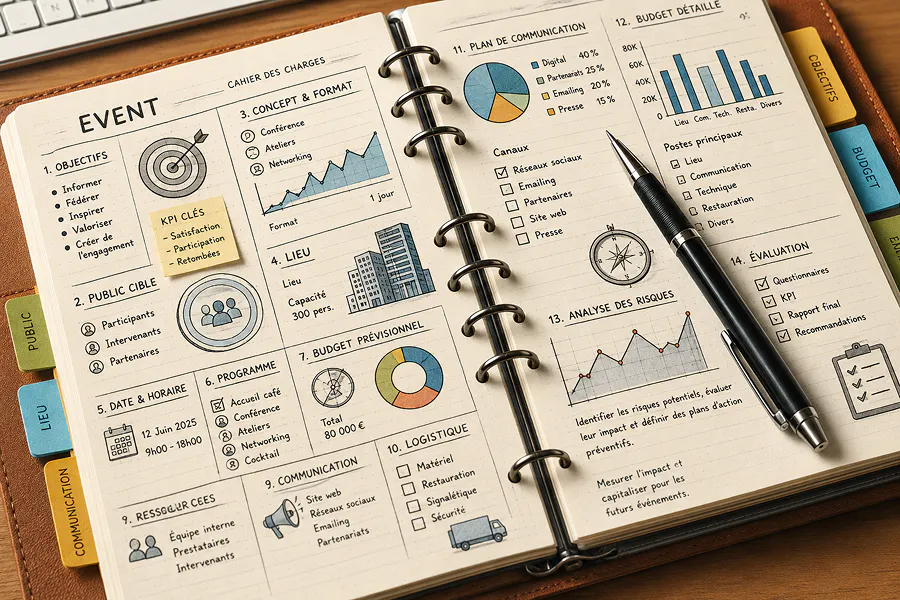
The specifications document, on the other hand, is operational and detailed: it frames the resources, logistics, and technical constraints. It serves as a working basis for vendors and agencies so they can propose a suitable response.
Use it:
- When preparing a complex event (conference, trade show, seminar, team building) requiring several vendors.
- When you have a clear vision of the event and want to receive detailed quotes.
- For a consultation or RFP with several event agencies.
For example, where a brief states: “We want to organize a conference for 500 people to promote our new software solution”, a specifications document details the venue, the budget, the schedule, and the needs in ticketing, check-in, and an attendee mobile app, etc.
To dig deeper into the topic of the event brief, click here.
“To put together an effective brief, everything comes down to thoroughness: you need to give your contact a precise understanding of the event you're picturing. It's better to add too many details than too few - that's how you'll get proposals that match your expectations, especially during RFPs. At Digitevent, we make sure to cover these expectations across many parts of your brief: event marketing, registration, access control, and attendee engagement. All on a single platform: keep that in mind!”
- Lucas Bohème - Key Accounts Manager at Digitevent
The essential elements of an event brief
Writing your event brief requires close attention to every detail - otherwise, your project will be less well structured. Take note of all the essential elements to include here.
General information
First, highlight the event's various stakeholders: advertiser, project manager, event agency, vendors, internal team, sponsors.
Also describe here:
- The type of event: is it a conference? A seminar? A trade show? A product launch?
- The event's objectives: do you want to generate brand visibility? Encourage networking among attendees? Boost company sales? Run training for your teams?
- The target audience: describe your audience, and specify exactly how many attendees to expect.
Key messages
In this second section, the goal is to formalize the message you want to convey during your event.
Start by describing the event's theme. Is it related to your products or services? Does it support the company's values or mission?
Also go into detail about the experience you want for attendees. What atmosphere do you want your event to convey? Do you have any requests regarding staging or style?
Budget
Here, the goal is to give your overall budget constraint, then break the budget down into different spending categories. Allocate your financial resources across venue rental, equipment, catering, communication, accommodation, transport, entertainment, etc.
Don't hesitate to rank these spending categories by priority based on your objectives. This will help your vendor have enough flexibility to align with both your budget and your objectives.
Logistics and technical requirements
This is where you get into the functional part of your brief.
On the logistics side, describe your event's constraints. These may relate to:
- Accessibility of the venue (particularly in terms of access for people with reduced mobility)
- Accommodation
- Transport
- Facilities
Also include your equipment constraints here. Highlight your needs in terms of sound, lighting, projection, video recording, internet connection, etc.
Program and schedule
Now it's time to describe how you envision your event unfolding.
Detail the agenda you want for your event. Specify the dates and times to plan for, as well as the talks and activities you want to include. Also describe the type of speakers and activities to plan.
If you need an event website built or an attendee app to communicate the program and manage registrations, mention it here as well.
Registration and guest management
In this section, specify exactly how you plan to manage invitations to your event.
Mention your needs in terms of registration methods and ticketing. Don't forget to mention whether you want to use specific technologies, such as an online registration platform to automate guest management, or a quick check-in system on the day to streamline arrival and avoid queues.
Best practice? Plan to use an event management solution like Digitevent, which lets you manage your invitations online, set up a registration platform, and securely control access to your events.
Communication and marketing
Now it's time for the part of your event brief covering your communication plan.
Define here:
- The expected event promotional materials: event website, social media, email, print formats, etc.
- The strategic need to attract and engage attendees. Note in particular, if needed, that you'll require an event app to boost attendee engagement.
Security and compliance
Remember to include a section on security in your event brief.
Include the creation of emergency plans, security measures, and insurance coverage. Also highlight the need to properly manage attendee access, as well as event badge control.
Measuring performance
The last part of your brief involves detailing the KPIs that will help assess the event's effectiveness, such as the number of attendees, engagement, feedback rate, etc. Also plan here to run satisfaction surveys to gather qualitative feedback.
Here again, an event management platform like Digitevent gives you access to detailed dashboards, and lets you easily collect the results of your satisfaction surveys. Keep that in mind!
How to write an effective event brief?
You now know how to put together a well-structured event brief. Here's how to proceed, in terms of the steps to follow and the tools to use.
The key steps
First, gather the needs of your various stakeholders. List all these stakeholders - both internal (management, marketing, sales, logistics, etc.) and external (vendors, partners, and sponsors). Then organize meetings or individual interviews to gather their expectations regarding event objectives, key messages to convey, and budget or logistical requirements.
Second, define the objectives and priorities of your event project. To do this, gather all your event's objectives, and prioritize them if needed.
To properly set your priorities, rank your objectives based on which ones bring the most value to your company or the department involved in the event. This lets you then indicate in the brief the essential elements that absolutely must be included in organizing the event, those that are important, and those that are optional.
Finally, move on to drafting and validating the detailed event brief with your vendors. Structure the brief clearly (you can draw inspiration from the structure described above). Validating your brief internally, before sending it to vendors, is crucial to ensure flawless alignment afterward.
The tools to use
To define your event brief, you can use a pre-filled template and customize it based on the elements you want it to include.
Also make sure to centralize all supporting documents on a document management tool (Drive) that will be made available to your potential vendors.
If you're creating your event brief as part of an RFP, also create a document to score the various applications based on the requirements and constraints.
This type of document is often an Excel spreadsheet listing each point mentioned in the brief. Each response provided by participants is then given a score, so potential vendors can be compared and an informed choice made.
6 mistakes to avoid in your event brief
Don't stop there: take the time to avoid the following six mistakes, for a flawless event brief!
Not going into enough detail
A brief that's too vague or poorly structured can confuse vendors and teams. So write a structured, detailed, and explicit document, with well-defined sections and specific figures.
Neglecting budget constraints
If you don't provide a prioritized budget breakdown, your vendor or project manager may miss one of your key objectives! Define an overall budget and a detailed budget by category (venue rental, catering, equipment, communication, etc.).
Forgetting to clearly identify stakeholders
Not stating who is responsible for what can cause misunderstandings and delays. In the first part of your event brief, define a specific role for each stakeholder: event agency, vendors, internal team, sponsors, etc.
Not including a precise schedule
The lack of key dates can throw your whole project into disarray. So include a detailed reverse timeline for your event, with deadlines for each task: choosing the venue, sending invitations, technical tests, etc.
Neglecting the attendee experience
A poorly organized event can frustrate attendees. If they lack information, have inadequate signage, or face a confusing program, your whole attendee experience suffers.
So plan for clear communication before and during the event in your brief. Also set up an event mobile app to centralize the program, maps, and notifications.
Writing a rigid, inflexible brief
A document that's too rigid prevents any adaptation to the unexpected. And as we know, an event very rarely goes exactly as planned! Build in a margin of flexibility and set up follow-up to adjust certain points as the project evolves.
What if you simplified organizing your events? From the brief stage onward, Digitevent and its intuitive event management platform support you with invitations, registrations, check-in, and engagement for your events. Enjoy simplified planning, and successful events!