
Are you thinking about creating your event website, or is your project already well underway - but have you included SEO optimization in your plans? Thanks to this three-letter acronym, your site becomes visible on search engines like Google.
Do you want to turn your event website into a magnet for attendees? You need to focus not only on SEO, but also on GEO, its counterpart for getting a site referenced by generative AI.
In this article, we explain everything you need to know on the topic, along with best practices for optimal SEO.
What is SEO (or organic search)?
SEO, acronym for Search Engine Optimization, or "référencement naturel" in French, is the art of optimizing your site so it appears in the search results of Google and other search engines , naturally, without paid advertising.
SEO rests on three pillars:
- The "technical" pillar. Among the technical SEO criteria to consider, you should make sure your website's structure is optimal and allows smooth navigation, that your site loads quickly, and that it displays correctly on all types of screens (desktop, tablet, mobile).
- The "popularity" pillar. Your event website needs links pointing to it (to prove its good reputation to search engines), but also links pointing to other authoritative sites (called outbound links).
- The "content" pillar. Your site needs content (static pages and blog articles) optimized around the keywords your target audience types into search engines. This content must offer real added value and be updated regularly.
It's important to understand that SEO is a long-term investment, unlike paid search advertising, known as SEA for Search Engine Advertising. Results from an SEO strategy can start appearing after three months, but it usually takes about six months to see real benefits. And above all, it's crucial to keep working on your strategy to maintain these results over time!
Why pay attention to SEO when creating your event website?
Wondering whether you should include SEO in the marketing checklist for your event site or platform? The answer is probably yes, and here's why.
The benefits of creating a well-referenced event website
Organic search for your event website is a real must-have for achieving one of these three goals:
- Attract visitors before the event. From your website, you can manage attendee registrations through a form, as well as publish and centralize the practical information they need. But to communicate effectively through your site, you need your guests to find it easily, including on search engines.
- Maintain a presence between editions, to boost attendee engagement. A well-referenced website lets you share recaps of the previous edition, or engaging content teasing the next one.
- Maximize conversion without spending more on advertising. The great advantage of SEO is that it increases your event's visibility without growing your event promotion budget.
Does your site really need an SEO strategy?
Depending on the type of event you're organizing, your SEO strategy may vary.
Case #1: one-off events
Let's start with the case where you're organizing a one-off event, such as a roadshow, a product launch, or a single conference. In this case, your event website will have a short lifespan (around three weeks).
SEO won't have time to take effect then. You'll therefore need to prioritize other marketing levers to promote your event, such as SEA, email, or direct communication. However, it will always be important to optimize your site's technical pillar, especially so it's smooth and easy to use for your attendees.
And don't forget: it's always possible to reuse this site for another event, to get more value from your SEO work. For example, you could create a main domain (such as "evenement-entreprise.fr"), then host your one-off pages on subdomains to capitalize on your main domain's authority.
Case #2: recurring events
Second scenario: websites for recurring events, such as annual trade shows. These sites stay active year-round, or are reused for each edition.
In this case, SEO becomes strategic for capturing visitors from one edition to the next, building on your brand's reputation, and ranking for recurring queries, for example "HR trade show registration 2025".
For example, for a trade show held every October, you'll need to work on SEO starting in February or March to gradually move your site up in the search results. Then, from September or October, you can activate SEA to boost registrations.
Just be careful to favor domain names without a year in them, so you can keep the same domain and keep building your SEO.
“SEO is a long-term effort, but by adopting the right habits, you can build a well-referenced website that attracts new attendees edition after edition. But be careful: while the "content" pillar is easy to manage yourself, the "technical" pillar can be more complex, particularly when it comes to site loading speed or security. To help you with this, you can call on a developer, or choose a turnkey solution like Digitevent”, Rémi Fontaine, Head of Customer Success
7 best practices for SEO optimization of your event website
From design to hosting, not to mention semantics and user experience, SEO requires attention to many details. Start by focusing on the following seven SEO best practices when creating your event website.
Check that your site is properly indexed
First, once your site is live, make sure it's properly indexed by search engines. To check this, try typing into Google: site: votredomaine.fr. If no results come up, your site isn't indexed yet.
To fix this, submit your sitemap to Google Search Console to get your pages indexed.
Need technical help with this? At Digitevent, we take care of setting up your Search Console when we create your event website.
Choose the right keywords
Every SEO strategy starts with researching the keywords you want your site to rank for, since this is the foundation on which you'll build your content.
The keywords you choose need to be relevant both to your target audience (your potential attendees actually type them into Google) and to your event offering (your keywords should accurately describe what you provide).
In your strategy, combine:
- Keywords centered on your event offering, especially industry keywords (like "HR trade show" or "IT conference"), and keywords related to topics your target audience cares about (like "cooking show").
- Intent-based keywords, like "trade show registration", "trade show program", or "trade show ticketing".
- Location-based keywords, where relevant, like "event in Lyon" or "Paris trade show".
This way, you can be sure to create a professional event website that will have good visibility on search engines.
Keep your site active all year round
If your event is recurring, it's crucial to regularly publish content on it , even outside your event promotion periods. This signals to Google that your site is active, and therefore credible, and therefore deserving of staying in the top positions in the results.
To keep your site active, consider publishing news, testimonials, replays, or photos from the previous edition. You can also host content co-created with partners.
Work on your backlinks
A "backlink" is an inbound link to your website. These backlinks are all signals to Google that your site has good authority, and therefore deserves to rank higher in the search results.
To build this "authority" pillar of your event website, encourage your partners, exhibitors, sponsors, and media contacts, and even clients, to add a link to your site on theirs.
Structure your URLs
For good SEO, your website's URLs need to be clear and consistent. Adopt a simple, effective naming convention. Avoid automatically generated or overly long URLs.
Here are a few tips for optimizing your URLs correctly:
- Choose the keyword the page has been optimized for
- Replace spaces with hyphens (-)
- Remove all accents, special characters, and stop words (words that aren't necessary for the overall understanding of the text)
For example, for a page optimized around the keyword "space and aeronautics trade show", the URL slug would be "/space-aeronautics-trade-show".
Take care with your tags and snippets in Google
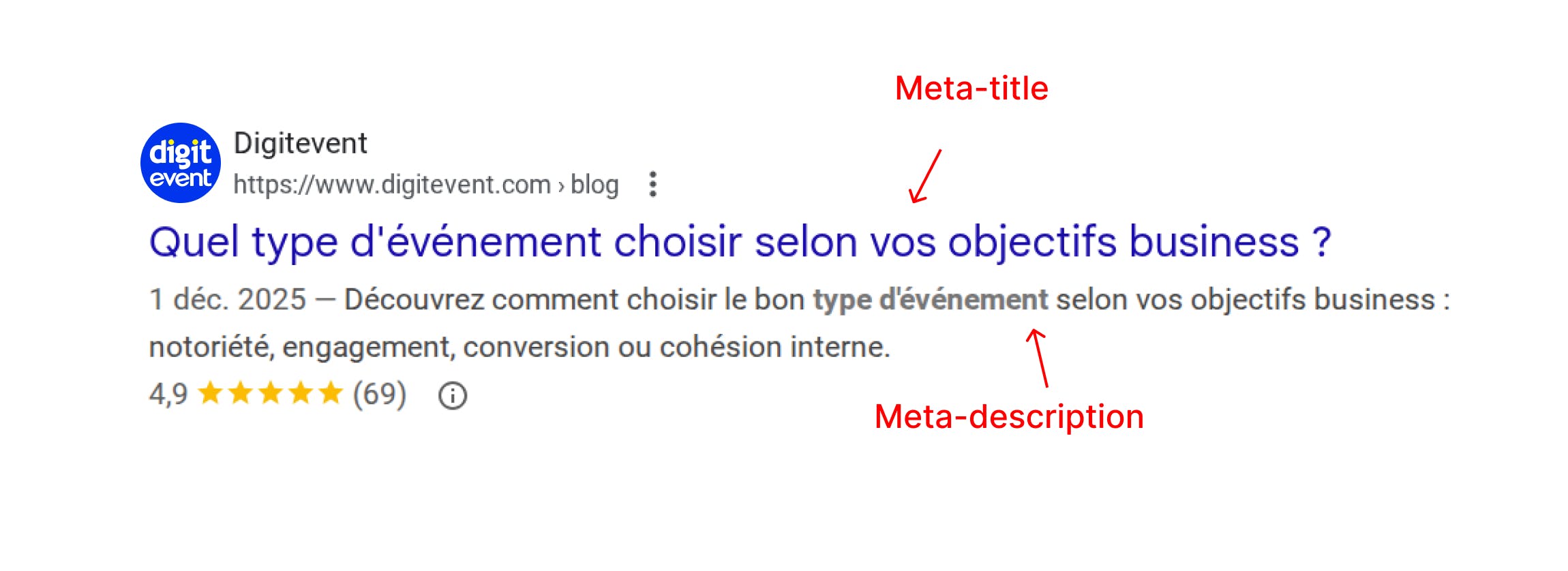
Whatever event website builder you use, it absolutely must let you customize what's known as your pages' meta-data.
Indeed, search engines don't just read the body of your event website's pages, but also the information found in the HTML code behind them.
Among the meta-data worth optimizing, we can mention:
- The meta title, the page title that appears in Google, which should be no more than 65 characters.
- The meta description, the description that appears below the title, which should be around 155 characters.
- The favicon, the small icon that appears next to your site's URL
In addition, when you add images to your event website, also remember to optimize the alt-text tag (or alternative text). This is the text read by assistive devices for visually impaired and blind users, as well as by Google's bots when they index your site.
Example of a SERP:
Don't forget AI engines
With the rise of generative AI tools like ChatGPT or Gemini, we're hearing more and more about GEO, for "Generative Engine Optimization". The idea: increase the chances of your site, and information about your event, appearing in AI responses.
While the ranking rules on these platforms remain fairly opaque for now, we do know that the websites that show up most often are those that answer very specific questions from their target audience.
Hence the value of:
- Enriching your content with FAQs on pages where it's relevant
- Providing clear, structured answers in your blog articles
- Writing clear, explicit titles on each of your web pages
- Personalizing your content based on the questions your target audience frequently asks
With these few best practices, you'll ensure basic but effective SEO management.
The tools to use for a well SEO-optimized event website
Any good event website creator should equip themselves with the following tools to succeed at SEO:
- Google Search Console. This free Google tool lets you check your site's indexing and track your SEO performance.
- Google PageSpeed Insights. This tool helps optimize your site's loading speed, a crucial element, especially on mobile.
- Google Lighthouse. A simple tool to check your site's mobile compatibility.
- Answer The Public. A useful platform for finding the questions your target audience is asking, so you can create relevant, personalized content for your visitors.
- Google Keyword Planner, Ubersuggest (free), or Semrush, Ahrefs (paid). These platforms let you choose your keywords and find out how many times they're searched each month on search engines.
- 1.fr, Thot SEO, or YourText.guru. These tools help optimize your pages' semantics around your keywords.
- Canva, to create attractive visuals for your event website.
- TinyPNG, to optimize the size of your visuals without slowing down your site
- Google Analytics 4, to track the results of your SEO strategy and understand your visitors' behavior: traffic sources, most-viewed pages, etc. Note: since this platform can be fairly complex to set up, Digitevent can help you with the setup, so you get advanced data on your audience.
Ready to optimize your event website for SEO? Discover Digitevent and its event website creation solution, as well as its personalized services to help boost your site's organic search.