Internal corporate events are one of the few levers capable of building a strong culture at scale.
How many people do you actually talk to each day at the office? Three, four, always the same ones. Yet you expect your employees to share a common vision, defend the same values, and embody the same employer brand.
This equation has become brutal today. The estimated cost of employee disengagement: 10 trillion dollars, or 9% of global GDP.
In this context, internal corporate events are no longer a nice-to-have expense. They're one of the few investments capable of producing a measurable effect on company culture, employee engagement, and talent retention.
But you have to stop running it on instinct. An annual seminar without clear objectives, without the right format, and without measuring impact remains an expensive party. Done well, it becomes the most defensible budget line in front of your finance department.
At Digitevent, we support more than 3,000 organizers who structure their internal events as a strategic investment. You'll see why culture is an asset, how events transmit it, which formats produce the most value, and which KPIs to use to prove it.
Employee engagement: the silent liability on your balance sheet
Recent figures are enough to worry your leadership.
The Gallup report shows this clearly: the decline affects managers first, whose engagement rate dropped by 9 points in three years. A historic drop, which spreads mechanically to frontline teams.
Employee experience is no longer a matter of comfort, it's a business differentiator.
This gap has a direct cost. The cost of replacing an employee represents several months of salary, sometimes up to twice their annual salary for skilled positions. Multiply that by an annual turnover rate of 15% and the issue becomes an executive committee priority.
Engagement can't be decreed. It rests on three levers that every survey confirms: quality management, regular recognition, a strong sense of belonging. These three levers aren't built through an internal email. They're tested in shared moments where culture becomes tangible.
That's precisely the role of an internal corporate event.
Before going further, let's set the record straight. Too many companies confuse culture, internal communication, and stated values. These are three distinct things.
Company culture: a strategic asset, not an HR poster
Define your company culture not by the values printed on your walls, but by the real behaviors your teams adopt every day. Culture is the gap between what you write and what your employees tell their friends.
It's also a financially quantifiable asset. O.C. Tanner finds that cultures embedding recognition are five times more likely to give their employees a sense of belonging. And regular recognition adds an average of 3.5 years of tenure per employee.
Multiply that by your average recruitment cost and you get an immediate return on investment.
A strong culture also produces speed. According to Deloitte, cited in the 2026 team-building trends, teams with clear collaboration rules reach their goals 1.7 times faster than others. Culture isn't an HR issue. It's an operational productivity issue.
Why do so many companies fail to build this culture? Because they approach it as a communication deliverable: a poster, an onboarding, a corporate video. Culture isn't broadcast, it's lived.
Your employees absorb values by watching their colleagues. They observe how leadership responds to difficult decisions. They also sense what their company celebrates publicly. Culture travels through collective rituals.
That's why internal corporate events hold a unique place. It's the only moment when 100% of your employees experience the same thing at the same time.
No other channel can produce this emotional alignment.
Why internal events have become the best cultural vehicle
No HR tool rivals shared experience.
Compare the channels available. An internal email generates a 20% open rate on average, and a distracted read. An intranet sees its traffic concentrated on utility pages. An e-learning module only engages for the strict duration of its use. A company convention brings together 100% of employees around 100% of the message.
Internal events act on three cultural levers that nothing else mobilizes at the same time.
Consistent information cascade
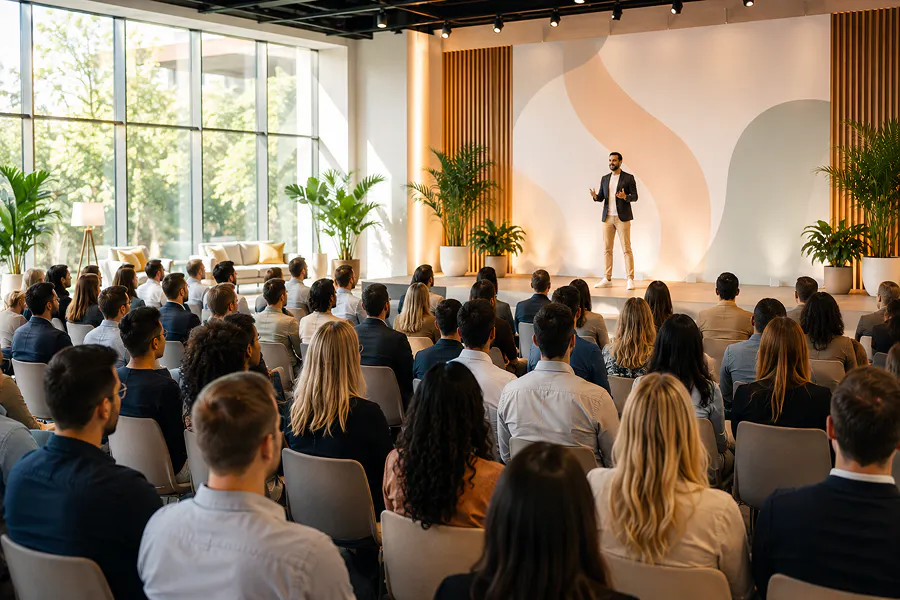
A company convention or kick-off aligns every team on strategy, priorities, and values within a few hours. You avoid the message getting distorted at each level of the hierarchy. The CEO speaks directly to every employee, at the same moment.
Building a shared history
Shared memories form the foundation of collective identity. An award ceremony experienced together, a memorable collaborative workshop, an unforgettable evening: all of this builds what neuroscience calls shared episodic memory. Your employees don't remember slide 47, they remember the moment.
Ritualized recognition
Handing out a trophy in front of 500 people is worth far more than a one-on-one compliment. Public recognition sets a collective standard and strengthens the employer brand. It also costs a lot less than a raise.
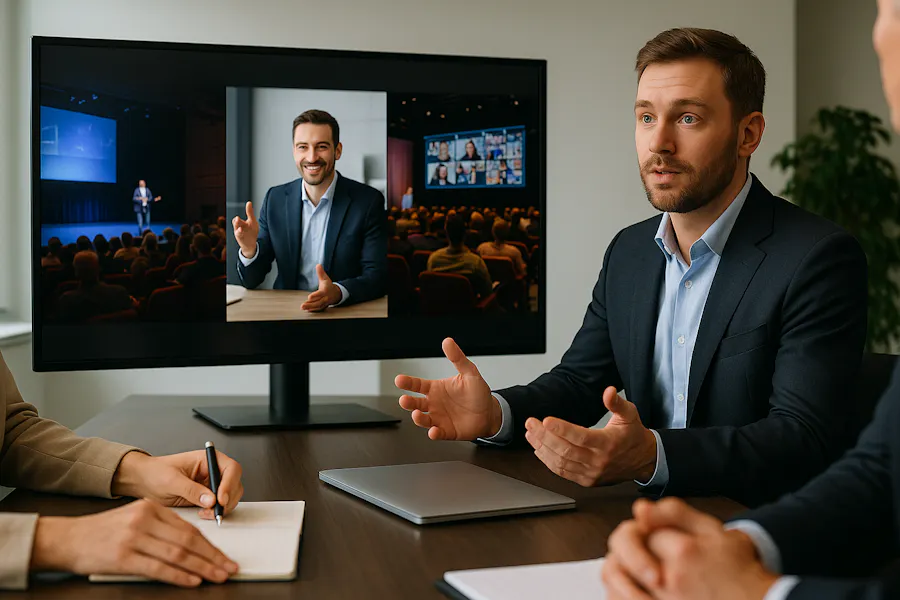
And for multi-site organizations, the hybrid format allows remote teams to be included without losing the magic of being there in person. A strong expectation on the employee side.
"Our annual convention has become our main tool for cultural alignment. It's the only moment when our France and Brazil teams share the same experience, at the same time. No email, no call, no internal document produces that result." - Jonathan Astruc, co-founder of Digitevent
This is what drives our clients to invest in platforms capable of industrializing these moments. Online registration, mobile event app, participant management, on-site badges: internal events are moving beyond a cottage-industry approach.
The 5 internal event formats with the highest cultural return
Not all formats are equal. Here's what works.
Before planning your next event, ask yourself one question: what do I want my employees to feel, remember, and tell others? The answer determines the format.
Here are the five canonical formats for internal events, ranked by dominant cultural objective:
- The company convention:
The go-to format for uniting people after a strategic transformation, a change in leadership, or an acquisition. Ideal for conveying the vision, launching a new direction, and bringing the employer brand to life as a whole. Target: 100% of employees or a core population (executives, sales teams).
- The company seminar:
A tighter format, at the scale of a team or business unit. Its strength: building fine-grained team cohesion, addressing operational topics in depth, and encouraging open dialogue. Typical duration: one to three days, often away from the office.
- The company kick-off:
Annual or per-campaign frequency. Rallies sales and marketing teams around short- and medium-term goals. Tone: energetic, motivating, action-oriented. Best avoided fully remote, as the impact suffers.
- Modern team building:
Forget go-karting and tree-top adventure courses for their own sake. The best modern team-building experiences recreate real professional situations. More and more immersive experiences tied to CSR issues are appearing in companies.
- The employee recognition event:
Gala evenings, award ceremonies, company anniversary celebrations. A format with strong retention leverage. Moderate cost, high memorable impact. Should be organized at least once a year.
Each format requires different tools. A convention for 1,000 people isn't managed like a team-building event for 30. That's why Digitevent offers an all-in-one platform capable of handling these variations: from an intimate seminar to an international convention in 19 languages.
Responsible internal events: the new cultural requirement
CSR is no longer a bonus. Your employees no longer see eco-responsibility as a marketing argument. They see it as a consistency test. A company that champions environmental commitment in its mission statement, then organizes a convention covered in plastic, loses internal credibility. And with it, employer brand.
Responsible internal events become the first barometer of this consistency. Four concrete levers make it actionable starting with your next event.
- Choice of venue:
Favor venues accessible by train. A seminar in Provence with 80% of attendees arriving by high-speed train saves several tons of CO2 compared to the same seminar served by plane. And arriving together by train kicks off the experience earlier.
- Local, plant-based catering:
Food weighs heavily on an event's footprint. A mostly plant-based menu, sourced locally, cuts the meal's footprint in half. Your employees have also become more demanding on this point.
- Full digitalization:
No more single-use laminated badges, no more paper programs, no more printed maps. A well-designed event app replaces all of that. It's also a signal sent to employees: the company practices what it preaches.
- Giving materials a second life:
No more useless goodies, reusable decor, furniture rented rather than thrown away. Applying zero-waste logic to events produces real savings, on top of the symbolic impact.
Responsible internal events also produce an unexpected side effect: they bring people together. Collective work around CSR choices becomes a cultural moment in itself. Your employees co-build an event that reflects who they are.
That's exactly what your employer brand needs today. Consistency that's lived, not just displayed.
Measuring cultural impact: the KPIs that matter
An unmeasured investment isn't defensible.
Too many internal corporate event organizers run into this objection from the executive committee: "What did it get us?" Without a hard number to answer, the budget shrinks the following year. Measurement isn't a nicety, it's budget survival.
Here are the KPIs to track systematically:
- Actual attendance rate. Beyond registrations, how many were physically present? A seminar with 95% attendance tells a different story than one with 65%.
- Post-event internal NPS. On a scale of 0 to 10, would your employees recommend the event to a colleague? An NPS above 50 indicates real cultural success.
- Satisfaction survey completion rate. Beyond the scores, the simple fact that your employees take 5 minutes to respond signals their level of investment.
- Post-event engagement. Mentions on internal networks, spontaneous shares on LinkedIn, requests for the next edition. All these subtle signals tell the story of collective memory.
- Differential retention. Compare the 6- and 12-month turnover rate of participants versus non-participants. This is the ultimate KPI, the one that defends your budget in front of the executive committee.
- eNPS trend. The employee Net Promoter Score is the benchmark indicator for employee engagement. Measure it before and after your event.
The point isn't to measure everything, but to measure what resonates with your leadership. A team seminar is measured in felt cohesion. A convention is measured in strategic alignment and eNPS.
A modern event platform automates this data collection. Live polls during the event, automatic questionnaires afterward, a real-time dashboard. You go from a "feel-good" seminar to a "data-driven" one, with no extra administrative burden.
Internal corporate events: your best cultural ROI
Internal corporate events are no longer an operating cost. They're one of the most powerful levers for building a strong culture, retaining your talent, and defending your employer brand in a tight labor market.
Provided you approach it as a strategic investment. Define your cultural objective before choosing your format. Build CSR in as an engagement multiplier. Measure the impact to defend your budget.
Current figures leave no room for amateurism. Your employees don't want to attend a repetitive convention, they expect a moment that justifies staying with your company.
At Digitevent, we've supported the most demanding professional event organizers since 2013. From conventions in 19 languages to intimate seminars, including sales kick-offs. More than 3,000 clients use our platform to turn their internal events into a measurable cultural lever.
Planning your next convention, seminar, or company kick-off?
Request a Digitevent demo and discover how to run your internal events as a true strategic investment.