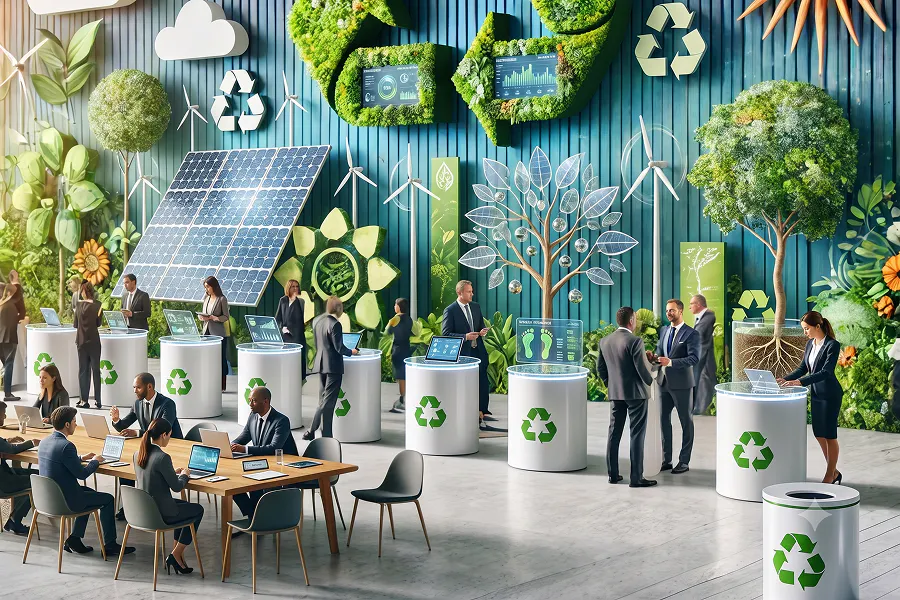
More than 80% of event professionals have already committed to a CSR approach. In other words: organizing an eco-responsible event is no longer a differentiating bonus, it's a standard expected by your attendees, clients, and stakeholders.
And with the CSRD directive, which requires large companies to provide detailed carbon reporting including their event activities, regulatory pressure now adds to public pressure.
However, event management requires attention to so many details that getting started with organizing eco-responsible events can seem complex. Where do you begin? Which actions help minimize your event's carbon footprint as much as possible?
In this article, we've gathered all the actions to consider for organizing an eco-responsible event, while still taking care of the experience your attendees have.
Ready to boost your attendees' engagement, and your own, when it comes to protecting the planet?
Why organize an eco-responsible event?
Thinking about environmental responsibility when organizing your events is no longer just a nice extra: it's an essential criterion.
Indeed, your clients and attendees are increasingly attentive to the environmental impact of the companies they interact with. Hence the need not only to have an internal CSR policy, but also to uphold it when organizing your events.
And the benefits of an eco-responsible event don't stop there. By adopting a sustainable approach, you can also:
- Meet new regulatory obligations. The CSRD directive requires large companies to provide detailed non-financial reporting, including a complete carbon footprint. Your corporate events, as an operational activity, fall within this scope, and often represent a significant source of emissions you can act on.
- Inspire and raise attendees' awareness of sustainability, and boost your brand image as a responsible company. Eco-responsibility generates positive emotions, even during your events.
- Optimize your costs. Reducing waste, limiting consumables, or working with local suppliers can generate savings over the long term.
- Strengthen your standing with stakeholders. Adopting a sustainable approach improves your relationship with sponsors, partners, and employees: all of them look for projects aligned with their values. On the agency side, CSR has become a structural criterion, systematically included in advertiser briefs (LÉVÉNEMENT Barometer).
That's plenty of good reasons to move toward more responsible event planning.
"In a world where every action counts, organizing an eco-responsible event is no longer an option, but a necessity. Far from limiting creativity, this approach pushes us to rethink every detail with intelligence and commitment, offering a more authentic experience aligned with the expectations of attendees who are increasingly aware of their impact. Every responsible event is an opportunity to prove that innovation and sustainability can go hand in hand.", Joy Grand, Marketing Manager at Digitevent
The main sources of environmental impact for an event
Launching a CSR-focused event means anticipating every area that could impact the environment, and optimizing it.
The Greenhouse Gas Protocol, adopted by ADEME, defines 3 scopes of greenhouse gas emissions:
- Scope 1 covers all of a company's direct greenhouse gas (GHG) emissions. This includes, for example, heating for premises or emissions from vehicles used.
- Scope 2 corresponds to indirect GHG emissions linked to the production of the energy used: electricity, steam, cooling, or heating.
- Scope 3 includes all direct and indirect GHG emissions from the various stakeholders: suppliers, vendors, and clients, across the event's entire value chain.
In events, this last scope is by far the heaviest. In practical terms, 70 to 90% of an event's emissions come from attendee transport.
Three structural choices therefore determine the bulk of your event's carbon footprint: the format (in-person, hybrid, or virtual), the venue (ideally accessible by train), and the geographic makeup of your audience.
More broadly, make sure to optimize the following five main sources of GHG emissions:
- Purchases: accommodation, staging, signage, etc.
- Transport: of goods, staff, speakers, and attendees
- Energy consumption: lighting, heating, air conditioning
- Food
- Waste production
All of these areas need to be factored into the organization of your eco-friendly event. This is precisely what's known as a low-carbon event: a structured approach to reducing the footprint from end to end.
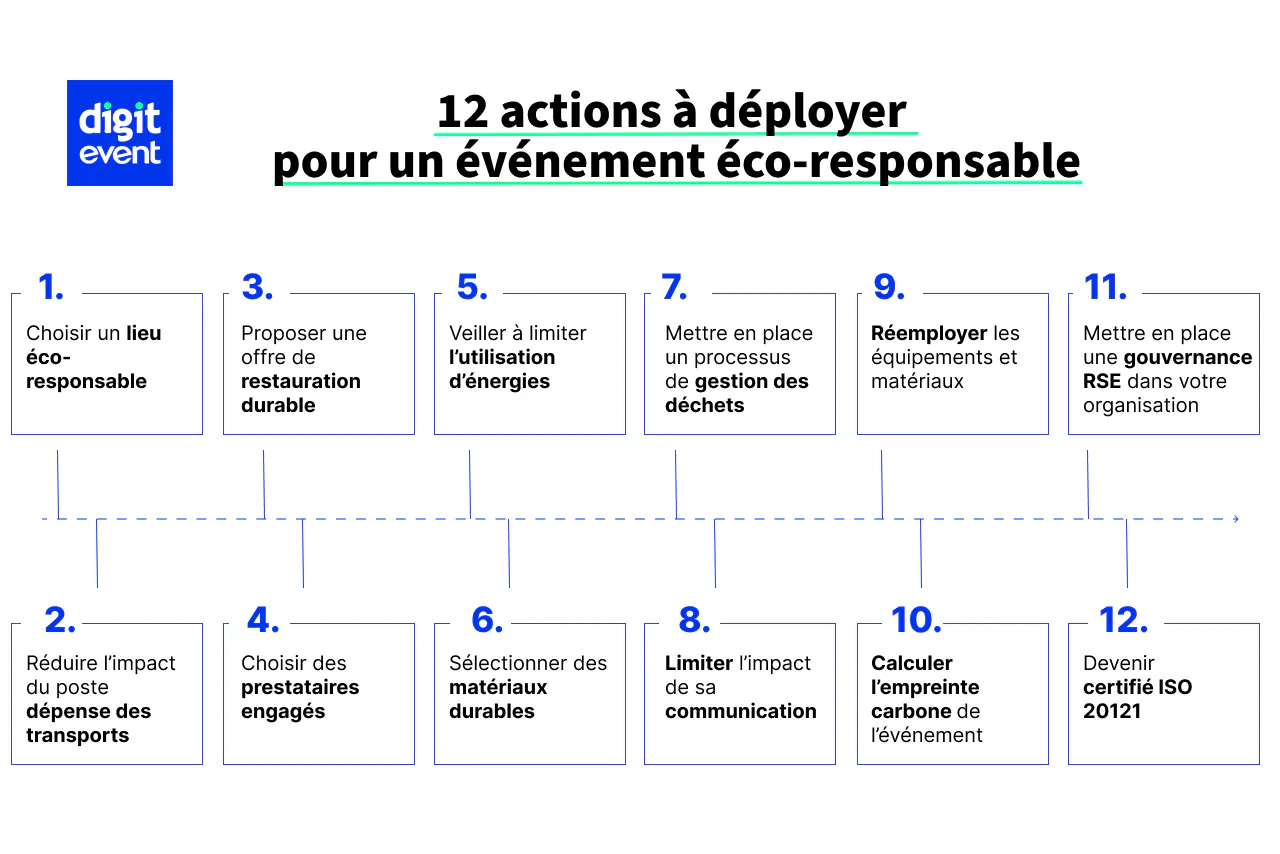
12 actions to implement for an eco-responsible event
Want to organize an event that's as environmentally friendly as possible? Apply the twelve best practices below to reduce your carbon footprint as much as possible.
1. Choose an eco-responsible venue
French event venues are reinventing themselves to meet the challenges of the ecological transition: low-carbon renovations, adaptations to climate change, more modular and resource-efficient spaces (UNIMEV, Event Data Book).
The range of eco-responsible event venues is therefore growing quickly: it's up to you to choose them over venues that are less committed to the environment.
In practical terms, remember to:
- Choose venues with official certifications, such as the HQE label, the European Ecolabel, or the Green Key.
- Calculate the geographic midpoint of each attendee's starting location, to choose a venue that limits travel, ideally in the city, with immediate proximity to public transport.
- Make your event virtual or hybrid to limit its carbon impact, especially when your audience is geographically spread out.
To go further, discover our selection of eco-responsible venues in the Île-de-France region.
2. Reduce the impact of transport
Since attendee transport is an event's top source of emissions, it's also the number one lever for action.
For example, you can:
- Provide guests with soft mobility services: electric shuttle, chauffeured bike, shared vehicles.
- Set up financial incentives for attendees who use sustainable modes of transport.
- Deploy a carpooling system among attendees, integrable directly into your registration platform.
Also remember to set rules for your team members when scouting venues ahead of the event. For example, limit visits to venues you already know, and if the trip can be made in under three hours, always choose the train over the plane.
3. Offer sustainable catering
In France, food accounts for 25% of the French population's carbon footprint (ADEME). Offering more eco-responsible catering can therefore have a major impact on your event's carbon footprint.
In practical terms:
- Offer a menu that's (at least partly) vegetarian rather than meat-based. Livestock farming is in fact responsible for 14.5% of greenhouse gas emissions worldwide (FAO).
- Set up a menu based on seasonal, local produce, from organic farming.
- Deploy an eco-cup deposit system to limit disposable cups.
- Use reusable tableware. Single-use tableware has in any case been banned under France's EGAlim law since 2023.
Organizations like Traiteurs de France can help direct you to the most eco-responsible caterer.
Also make sure to plan quantities carefully to avoid food waste. To limit waste, offer attendees doggy bags or work with an outreach organization that collects unused food to redistribute it.
4. Choose environmentally committed vendors
Let's focus on scope 3, the heaviest one: your vendors need to be as committed to eco-responsibility as you are.
Run a benchmark of CSR-focused vendors. When you contact them, highlight your CSR policy to check that they're aligned with your own commitments.
And ask them for concrete, quantified proof of their eco-responsible actions: the carbon impact of the solutions they propose, eco-friendly delivery methods, certifications obtained, and continuous improvement efforts.
5. Limit energy use during the event
Your event's ecological footprint can drop significantly if you optimize on-site energy consumption.
For lighting, make the most of natural light, as well as the lighting already available at the selected venue, without adding more. Also choose low-consumption LED lighting.
For eco-responsible water use, choose a venue equipped with water recovery systems or low-flow taps. Set up drinking water stations where attendees can refill their water bottles.
For heating and air conditioning, make the most of natural ventilation. In summer, choose a venue that lets you use an outdoor space. If you need heating or air conditioning, set up a temperature regulation system to keep the environment comfortable without overconsuming.
Overall, remember to use energy consumption monitoring systems to reduce it as much as possible. Also encourage your attendees and staff to turn off lights and electronic devices they aren't using.
6. Select sustainable materials
For your decor, giveaways, or packaging, favor eco-responsible materials.
For example:
- Signage made from recycled cardboard rather than plastic.
- Eco-responsible giveaways: recycled or recyclable materials, branded water bottles, useful items rather than gadgets.
- Digital gifts (gift cards, show tickets, donations to a charity) rather than physical gifts.
Don't hesitate to build storytelling around your sustainable material choices, to demonstrate their CSR impact and inspire your attendees.
7. Set up a waste management process
Even an eco-responsible event inevitably generates waste. It's up to you to set up the right process to manage and repurpose it.
To do this:
- Set up a sorting system on site, including a compost bin for organic waste.
- Put up clear signage to get attendees involved in responsibly managing their waste.
- Assign a dedicated team to waste management during the event, to make sure nothing is left to chance.
The zero-waste event doesn't exist, but your event should come as close to it as possible.
8. Limit the impact of your event communication
Ahead of your event, remember to limit the environmental impact of your communication.
Favor digital materials. If you choose physical materials, opt for printing on recycled, recyclable paper with eco-responsible inks.
What if you digitized your invitation and registration system?
Your attendees are now used to registering for events online, on their own. Deploy an event platform that lets you send invitations and manage registrations with complete peace of mind. That's what Digitevent offers, as a partner for your eco-responsible events. The extra touch? Our servers partly run on renewable energy.
9. Reuse equipment and materials after the event
Say goodbye to single use: make sure to reuse all your equipment for future events. This means designing your furniture, staging, and decor so they can be reused afterward.
Another option: source this equipment secondhand, or rent eco-designed furniture from specialized vendors.
10. Calculate the event's carbon footprint in advance
Before the big day, once you've gone through all these best practices, make sure to calculate your event's theoretical carbon footprint. It's the only way to identify priority levers for action, and to measure your progress from one event to the next.
There are platforms specifically dedicated to organizers of low-carbon events, such as:
- ICE (Impact Carbone Événements): a simulator developed by LÉVÉNEMENT, based on ADEME's Bilan Carbone® methodology, which lets you estimate a project's carbon impact from its earliest planning stages.
- CLEO Carbone: an emissions measurement and reduction platform developed by UNIMEV and Choose Paris Region, with preferential rates for Unimev, LÉVÉNEMENT, or Traiteurs de France members.
Note: SMEs can access the Diag Décarbon'Action program funded by ADEME and Bpifrance, with an out-of-pocket cost of €6,000 excl. VAT to carry out their Bilan Carbone®.
Remember to include the carbon footprint of your digital actions in this calculation (online invitations, digital communication, attendee app, etc.).
The best practice? Train one of your team members on this calculation, so they can carry it out ahead of each of your events. And don't forget to factor this data into your event KPIs to steer your approach over the long term.
11. Set up CSR governance within your organization
Whether at an agency or on the client side, make sure you have dedicated governance for your eco-responsible events strategy.
This body needs the skills to measure an event's carbon impact and to keep up to date on best practices on an ongoing basis. It could be a team member specifically dedicated to this mission or, within a company, someone from the CSR department in charge of events.
This governance makes real sense in a CSRD context: the data collected event after event feeds directly into the company's non-financial reporting.
12. Aim for ISO 20121 certification
The ISO 20121 standard organizes the management and responsible production steps of an event activity. It structures a continuous improvement approach in terms of CSR.
Its revised version, ISO 20121:2024, has been better aligned with the UN's Sustainable Development Goals, and strengthens requirements around transparency, inclusion, stakeholder engagement, and shared governance. Organizations now need to demonstrate concrete, defined, and measured results.
Good news: France is the world's leading country in number of ISO 20121 certifications, accounting for 45% of certificates issued. And the 2024 Paris Olympic and Paralympic Games were the first event in the world to be certified ISO 20121:2024. What if you followed the same path?
One last tip: use every eco-responsible event you run to inspire the next ones. Gather feedback from all your stakeholders (internal clients, external clients, attendees), build a directory of environmentally committed vendors, reuse your staging and decor, and reapply the best practices that worked.
Want to digitize your registrations and limit the footprint of your event operations? Request your Digitevent demo.
V2 - 30/06/2026